Retirement planning critical illness: Compare personalized retirement planning with critical illness

Last Updated: October 19, 2026
[Retirement planning](/blog/retirement-planning-services-for-women/) critical illness protection serve different purposes but are deeply interconnected: one builds wealth for your later years, the other safeguards it when health crises strike.
Many people treat these as separate decisions, adding insurance almost as an afterthought. But a critical illness, heart attack, cancer, stroke, can derail even the best-laid retirement strategy: medical costs spike, you may stop working, and savings drain faster than anticipated.
The solution isn’t choosing between retirement planning and critical illness protection, it’s designing both together.
This guide explains how both work, where they overlap, and how to build a strategy that protects your financial future.
Retirement planning creates a roadmap for your financial life after you stop working. It answers a core question: will your savings, investments, and income sources last as long as you do?
Effective retirement planning strategies address three objectives: estimate how much you’ll need, determine how much to save now, and create a withdrawal plan that makes your money last.
Most plans account for living expenses, healthcare, travel, and legacy goals, projecting inflation, investment returns, life expectancy, and income sources like Social Security and pensions.
But standard retirement planning often misses a critical variable: what happens when a major health event disrupts your income or dramatically increases your expenses, which is why retirement planning critical illness coverage must work together. That’s where critical illness financial planning becomes essential.
Retirement planning strategies must address interconnected risks: market downturns that slash portfolio value when you need it most, inflation eroding purchasing power, and healthcare costs that exceed expectations.
But the biggest blind spot is the impact of a critical illness. A cancer, heart disease, or stroke diagnosis doesn’t just create medical bills, it can force you to stop working or tap retirement savings years ahead of schedule.
Long-term care presents another challenge: a stroke or degenerative illness may require nursing home, assisted living, or in-home support, running tens of thousands annually and depleting a lifetime of savings within a few years.
Critical illness insurance is a specific type of financial protection. It pays a lump sum if you’re diagnosed with a covered condition, typically heart attack, stroke, cancer, or organ transplant.
Unlike health insurance, which reimburses medical expenses, critical illness insurance gives you cash. You decide how to use it: pay medical bills, replace lost income, cover care expenses, or preserve retirement savings.
A critical illness diagnosis often triggers a financial cascade.
This hits hardest for self-employed people and small business owners, where a three-month recovery means three months of zero business income. Salaried employees may get partial short-term disability, but rarely 100%.
The third impact is accelerated spending, home help, living-space modifications, specialized care, expenses that add up quickly and often aren’t covered by health insurance.
Critical illness protection addresses this gap. The lump sum payment lets you cover these expenses without liquidating retirement accounts. You avoid forced early withdrawals, which trigger taxes and penalties.
Critical illness policies pay a lump sum when you’re diagnosed with a covered condition and meet the policy’s definition, typically between $25,000 and $500,000 depending on your policy.
Important: policies define conditions specifically. A “heart attack” might require specific test results and minimum damage to heart tissue. A “cancer” diagnosis usually requires malignant tumors, excluding early-stage or non-invasive cancers.
Policies also have exclusions and waiting periods: pre-existing conditions typically aren’t covered, some exclude certain cancers, and waiting periods (usually 30 days) delay benefits for conditions diagnosed right after purchase.
A policy that seems comprehensive may exclude the exact condition you fear most, which is why working with someone who understands policy details matters.
These three types of protection serve different purposes and work together, not as alternatives.
Health insurance covers medical expenses, doctor visits, hospital stays, medications, treatments, reimbursing actual costs but often with deductibles, copays, and limits. It doesn’t replace lost income or cover non-medical expenses.
Disability insurance replaces a percentage of income if you can’t work due to illness or injury, short-term for 3-6 months, long-term until retirement age, but usually only 50-70% of salary, often after waiting periods.
For retirement planning, this matters enormously: health insurance protects against medical expenses, disability insurance protects income while working, and critical illness insurance protects retirement savings from being raided.
| Protection Type | Covers | Benefit Structure | Best For |
|---|---|---|---|
| Health Insurance | Medical expenses | Reimburses actual costs | Hospital, doctor, treatment bills |
| Disability Insurance | Lost income | Replaces percentage of salary | Income replacement while unable to work |
| Critical Illness Insurance | Financial impact of diagnosis | Lump sum payment | Covering gaps, preserving retirement savings |
Effective retirement planning requires protection against multiple risks simultaneously, market volatility, inflation, healthcare costs, and critical illness, and no single strategy addresses all of them.
A comprehensive approach layers protections: investment strategy to build wealth, insurance against catastrophic events, and flexibility to adjust as circumstances change.
Long-term care planning is often overlooked.
Long-term care can cost $50,000-$100,000+ annually depending on location and care type; a five-year period could exceed $300,000, for many, a larger expense than any other retirement cost.
Long-term care insurance exists for this risk but isn’t right for everyone: policies can be expensive and eligibility requirements have tightened.
The key is acknowledging the risk explicitly, ignoring long-term care costs means your retirement plan is incomplete and you’re hoping rather than preparing. (Source: National Cancer Institute’s statistics on cancer survival rates)
Asset protection also involves tax strategy. Withdrawals from traditional retirement accounts trigger income tax. Large withdrawals in a single year could push you into higher tax brackets.
Life insurance serves different purposes at different life stages. During working years, it replaces income if you die prematurely, protecting your family’s financial security.
But life insurance also plays a protective role in retirement. Some policies include living benefits, cash you can access while alive if you face serious illness or need long-term care.
For people with dependents or significant debt, life insurance remains essential in retirement. It ensures your family isn’t burdened with mortgage payments or other obligations if you die unexpectedly.
Income protection in retirement also means diversifying your income sources. Social Security provides a foundation, but it’s usually insufficient alone. Pensions, annuities, investment income, and part-time work create multiple streams.
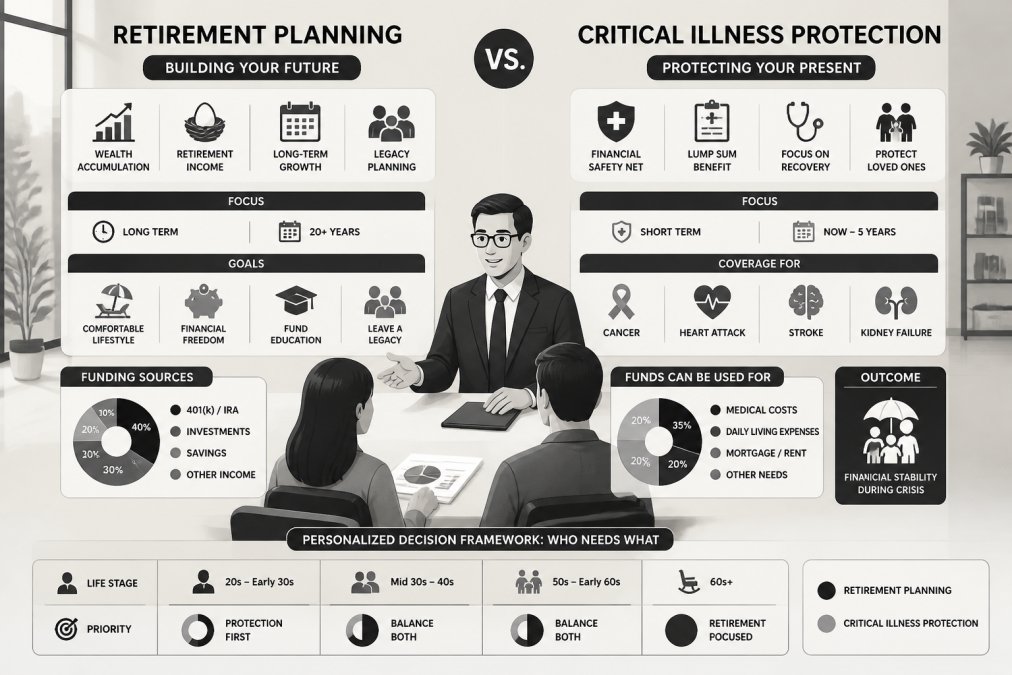
The right combination of retirement planning and critical illness protection depends on your specific circumstances. Age, health, income, family structure, and business situation all matter.
Your approach changes as you move through different life stages.
In your 40s, you’re likely still working and building retirement savings. Critical illness risk is lower statistically, but the financial impact is severe, you could lose decades of earnings. Disability insurance and critical illness protection make sense alongside aggressive retirement savings.
In your 50s, retirement approaches but feels distant enough to plan around. Healthcare costs begin rising. Critical illness risk increases.
In your 60s and early retirement, you’re transitioning from accumulation to distribution. Your focus shifts from building assets to preserving them. Critical illness protection remains valuable, a major health event could derail your entire retirement plan. Long-term care planning becomes urgent rather than theoretical.
Single people with no dependents need different protection than families with children or aging parents to support.
A single person might prioritize retirement savings over critical illness insurance, since no one depends on their income.
Married couples should coordinate their plans. If one spouse manages finances while the other works, the working spouse’s income protection becomes critical.
Parents supporting adult children or aging parents face additional complexity. Your retirement plan must account for these obligations.
Self-employed people and small business owners face unique retirement planning challenges. Business income is unpredictable. You don’t have employer-provided benefits. Business and personal finances are often intertwined.
For business owners, disability insurance and critical illness protection serve dual purposes. They replace lost business income and personal income simultaneously. A three-month illness could devastate both your business and personal finances.
Retirement planning for business owners must account for business succession. If you become unable to work, who runs the business? Can it be sold? How much is it worth?
Critical illness insurance provides cash flow during recovery, keeping the business operational while you heal. For some owners, it’s the difference between business survival and closure.
Most people have some existing protection they don’t fully use. Understanding what you already have prevents gaps and overlaps.
Social Security provides retirement income starting at age 62 (with reduced benefits) or 67 (full benefits).
Medicare begins at age 65 and covers hospital care, doctor visits, and some medications. But it has significant gaps, it doesn’t cover long-term care, dental, vision, or hearing aids.
Employer-provided benefits often include health insurance, disability insurance, and sometimes life insurance. If you’re still working, maximize these benefits before buying individual policies.
The coordination question is crucial: does your critical illness insurance duplicate coverage you already have? Or does it fill genuine gaps?
Effective retirement planning integrates retirement savings, insurance protection, tax strategy, and healthcare planning into one coherent approach.
Start by defining your retirement vision. How much income do you need? What lifestyle do you want? What are your legacy goals?
Next, quantify your risks. What’s your health history? What healthcare costs do you anticipate?
Then, design your protection layers. Retirement accounts and investments form the foundation. Insurance fills gaps that savings alone can’t cover.
Finally, stress-test your plan against major scenarios. What if the market drops 30%? What if you’re diagnosed with cancer at 55?
This comprehensive approach, addressing retirement planning and critical illness protection together, is what separates solid financial plans from incomplete ones.
At Lineage Guardians, we specialize in building these comprehensive strategies for families often overlooked by traditional financial institutions. Our Million Dollar Baby strategy focuses specifically on preventing you from outliving your retirement savings while protecting against life’s biggest financial challenges. Book a Call to discuss how we can help you build a retirement plan that truly protects your financial future.
Personalized retirement planning focuses on building a financial strategy to support your lifestyle across decades, addressing market volatility, inflation, and longevity risk. Critical illness protection is designed to replace income and cover out-of-pocket medical and care costs if you’re diagnosed with a serious condition. Together, they form a complete financial safeguard: one preserves your retirement income stream, the other protects that stream from being depleted by a health crisis.
Yes. A critical illness diagnosis can trigger forced early withdrawals from retirement accounts, incur substantial medical bills and extended care expenses, and interrupt your income if you’re unable to work. These costs can accelerate asset depletion and leave you at risk of outliving your savings. Critical illness insurance bridges this gap by providing a lump-sum benefit to cover expenses without forcing you to liquidate retirement accounts.
Families should prepare for market downturns (falling stock values), inflation eroding purchasing power, unexpected healthcare costs, long-term care expenses, critical illness or disability, premature death of an income earner, and forced early retirement due to health issues. A comprehensive financial plan addresses each risk through a combination of retirement planning strategies, insurance coverage, and asset protection to ensure financial stability across multiple scenarios.
Start by assessing your family’s specific risks: dependents, business ownership, health history, and income sources. Then allocate resources across both retirement savings vehicles (401k, IRA, business retirement plans) and protective insurance (life, disability, critical illness). Many families find that protecting against catastrophic risks first, through critical illness and life insurance, creates the financial buffer needed to invest retirement savings confidently without fear of total depletion.